Today’s American shaman
That is, a positive substitution is made with
Every plurality of bodies has a particular shape; every particular pattern can be a signifier; so any plurality of bodies can convey a potential message. A cloud, a tree, the lay of sediment against a contrasting background (e.g., tea leaves), cracks in a baking cow scapula—everything multipart can convey a pattern, and patterns can be typed and read as signifiers. There are a million ways to arrange sand granules into a signifier of cat.
Yes, any plurality of bodies can convey—and this brings us to a precipice. The random heap of dark brown speckles. Looks like dirt. Like Sartre’s mud-being. Nothing could have less essence, less categoricity, less identifying predicability. And yet the diviner sees it as already essential. Some beings only exist because they help us meet our ends, or give pleasure to our striving that uniquely satisfying that striving. There is pleasure that is just masturbatory
I know wha
(but currently unanswerable) question
glean important information about a pertinent but unavailable question by reading the accidental—what is impertinent and casually disconnected. Every plurality of bodies has a particular shape; every particular pattern can be a signifier; so any plurality of bodies conveys a potential message. A cloud, a tree, the lay of sediment against a contrasting background (e.g., tea leaves), cracks in a baking cow scapula—everything multipart can convey a pattern, and patterns can be typed and read as signifiers. There are a million ways to arrange sand granules into a signifier of cat.
The social function of the shaman is to scan the environment for patterns in order to get info for practical action.
Now, anyone can get info about X directly—through ordinary (local) body action or “low magick” as it is called by post-Crowley occultists. Low magic is a fancy phrase meant to remind us that every intentional act is a magickal act, provided that causal closure is false. That this is so is not apparent when looking at the links between peripheral effects of an intentional action, but only when looking at the act’s origination. Not the link between spine and finger, or brain and spine, but between a hypothetically free agentive causality and its mysterious link with a physical brain that is entirely causally enmeshed. That is to say, the “magick” lies in either (1) the original act of creating the intention (“from nothing,” as they say) or (2) the act of choosing to act on that intention. Either is an instance of some wild, acausal force breaking into the causal chains of physical becoming. Either is sufficient.
It simply means local body action directly applied to locally influenceable objects whose links to the intended results are intelligible. This includes hammering a nail and ordering pizza by phone. Both are locally applied body action—hammer swinging force and
What about phone calls that yield effects?
We can call these “local operations” instead to avoid undue excitement.
Recall that magick means “effort exerted to cause some intended change.” For example, let’s say I want to change my state from ignorance to knowing regarding the number of eggs in a basket. The local operation to effect this intentional change is this:
- Locate the basket.
- Manipulate the basket with hands while looking.
But what if the basket is hidden from me? What if I’ve never even seen the basket, but merely heard of it.
Enter the shaman, the person whose social function is to operate on unavailable objects—that is, such as baskets that are far away, or even whose existence is uncertain. The function of the shaman is to take action when action by local operation cannot work. It is doing substitutionary action when real action is impossible. When this action is one of perception, the shaman will transport his vision (or hearing) across distances where real perception is impossible. In our example, the shaman will substitute some other kind of looking for the local operation—for example, he might check to see how many birds there are in a given tree. Or see what number-shaped crack (or how many cracks) are made in a heated bone, and have that serve as the signifier for the number of eggs.
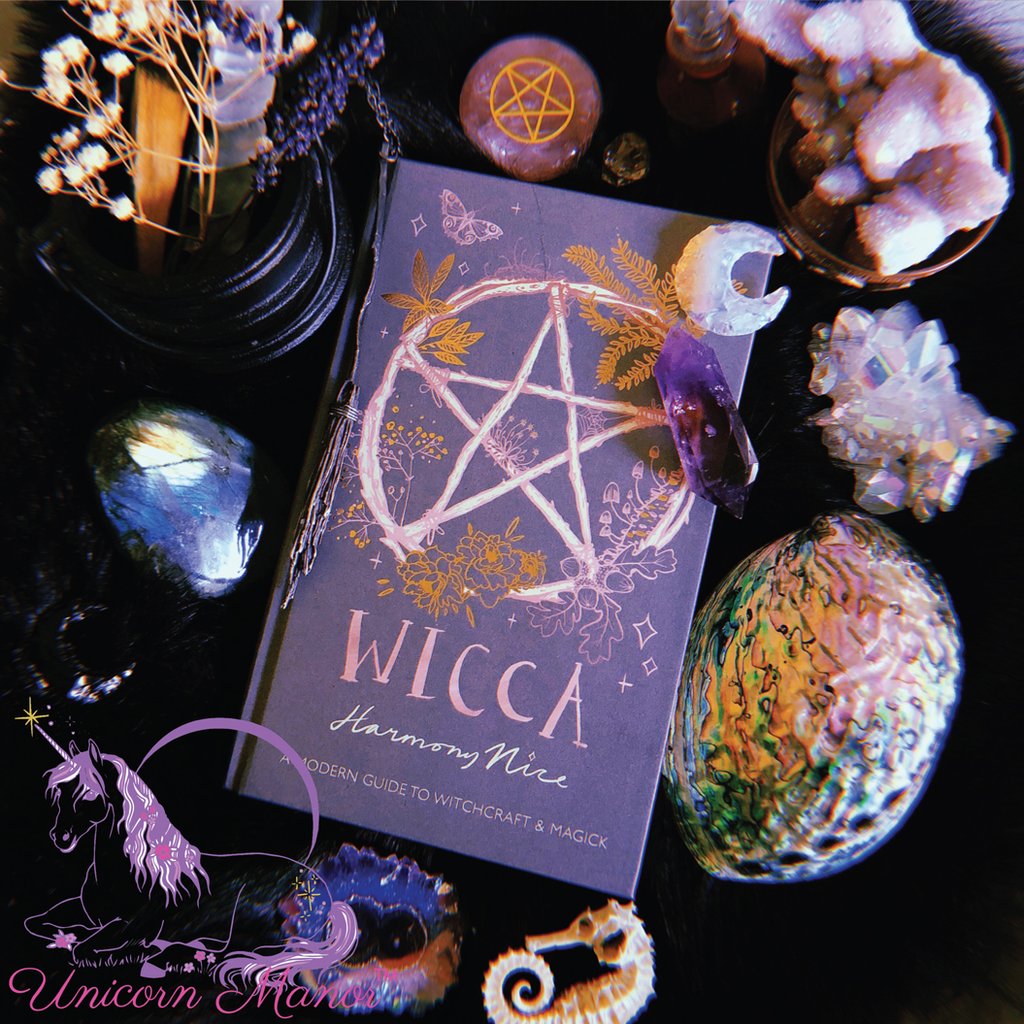
The idea of selling Satanism-light next to the bath salts and potpourri at Whole Foods would cause riots back in the early 1980s. Yet here we are.
My friend Paul Clemens is writing a short story about a Trump follower who also happens to be a zealous neophyte occultist and narcissist. You know the type—the ardent neophyte occultist, usually young or undereducated, and totally excited about the deep and absolutely true bit of metaphorical correspondence she just memorized from Wicca for Beginners, which Oprah recommended. Something life-changing like, “God is love, and I am God, so I love you all.” Or “The wand symbolizes the penis and means the will.” She interprets things differently now. Normally probable events become messages to her from the Synchronicity God. Things that happen will confirm the new truths, or will obviously be the effects of her new metaphysical friends. Things will be unified thematically according to a new mythos. She well exude certainty and a knowing smile no matter how hard things get, for its just the Goddess testing her. Her eyes get wide as she tells you (with that knowing smile) about all the synchronicities the Goddess has provided lately.
It is this mindset, the semi-schizophrenic perception of the world as all-about-me, that distinguishes the zealous American neophyte shaman (ZANS) from the pre-literate high-functioning schizophrenic. The mind and perception of the ZANS is far away, perceiving the strings linking every atom to the [control rod] held by the divine puppet master. But the master is the ZANS’ BFF and a private god—one that favors the ZANS. (Christians talk this way, too. They say, “My God is …” and so on. This is god as weapon.)
NANS
Naive American Zealos Idiot
Divinatory shamanism
What is a shaman in the most generic sense? A shaman is someone who reads unity from plurality in terms of personal significance. What distinguishes the ZANS from shaman-kind generally? The differences lie in (1) the faculty of perception, (2) the objects used as signifiers, and (3) the context for interpretation. The faculty is selective attention, the objects are everything in perceptual reach, and the context is the assumption that the universe is not only ego-centric, but smart enough to stimulate just the right private (biographical) associations in your noema to get the point across. The universe “knows me well”—it knows that my seeing a blond girl in a blue dress walking that way will remind me of X, which leads to Y, and finally to Z, if Z is relevant to the question or problem P at hand. All this I articulate by saying,
The universe is telling me that I should do Z about P.
In general, the more enmeshed the method of divination (perception), the better. (Crowley uses this principle to build error checking into his algorithm for tarot card-reading.) So instead of casting yarrow stalks or coins, or burning a bovine scapula, today’s American shaman will do Internet searches and follow hyperlinks until something significant comes up.
Magickal shamanism
Similar “sensitivity to environmental conditions” can be an impetus to magick. Inspired by the movie Hereditary (2018), a friend of mine did the following. He described his “working” and I’ve reenacted it here for educational purposes:
1. Let the universe reveal the Tao currently supporting me
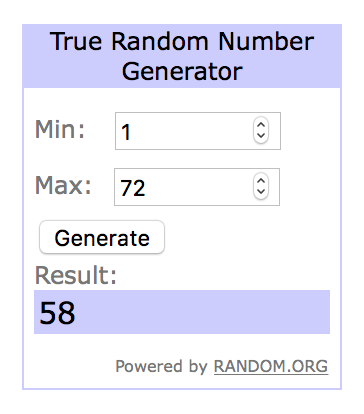
My result from RANDOM.ORG.
We have tools today that access the Tao better than yarrow stalks and coins. Better even than random number generators, which of course are deterministic, and the seed value we supply them are, too, if our brains are. And once the seed value is given, the series is set by a single algorithm, which means that even if our seed choice really were a pulling-down from the void, the sequence is not truly random.
But there are also true random number generators, such as the one at RANDOM.ORG that uses atmospheric noise for its random picks. And, so, I went there and had The Universe pick a number between 1 and 72. What you see above was the result.
2. Look up the demon with that index in a standard grimoire
The Mathers-Crowley Goetia translation (1904) gives this:
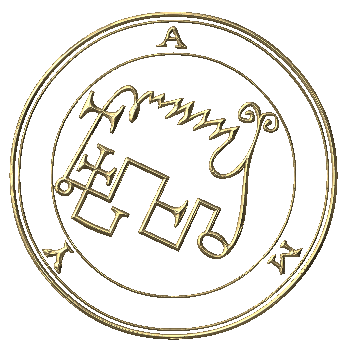
His sigil.
(58.) AMY, or AVNAS. — The Fifty-eighth Spirit is Amy, or Avnas. He is a Great President, and appeareth at first in the Form of a Flaming Fire; but after a while he putteth on the Shape of a Man. His office is to make one Wonderful Knowing in Astrology and all the Liberal Sciences. He giveth Good Familiars, and can bewray Treasure that is kept by Spirits. He governeth 36 Legions of Spirits, and his Seal is this, etc.
The Pseudomonarchia daemonum (Johann Wier, 1583) gives this:
Amy is a great president, and appeareth in a flame of fier, but having taken mans shape, he maketh one marvelous in astrologie, and in all the liberall sciences, he procureth excellent familiars, he bewraieth treasures preserved by spirits, he hath the governement of thirtie six legions, he is partlie of the order of angels, partlie of potestats, he hopeth after a thousand two hundreth yeares to returne to the seventh throne: which is not credible.
3. Do the work
Oh good—liberal arts is just where I’m at with these shitty, rambling little posts that I only finish out of a sense of duty when I realize that their initial premise was wrong (or I didn’t type fast enough to capture the original feeling but keep going anyway). So the demon AMY is the part that semi-autonomous aspect of my intelligence that the Tao recommended as being ready to work with me. AMY, a module of my own capacity, dressed in some mnemonic figure and anthropomorphized for the sake of convenience, and ready to be commanded. My job is to force this aspect to visible appearance, convince it to tarry for a while as I alternatively interrogate it (Why is my writing so shitty so often!?) and give it commands (Teach me to make good outlines!). The result is increase executive agency over my various disparate capacities and improved integration and so on. The method is natural for the assumptions: “I” (my rational interest in long-term goods) penetrate my own component volitional organs, explore their recalcitrance, open them up, and convince (or force) them to get on board and help me accomplish my goals.
The silly and arbitrary style of this little anthropoid is to appear first as flame and then as a dude—specifically, a President. And educated President, he teaches astronomy and liberal arts, gives familiars, incites positive reactions from rulers, and reveals treasures that are hidden by similar personifications. He’s also in constant pain, the pain of pining for reunion with the Over-Self, from whom it has fallen into a state of being a detached compartment, a fragment of self gone astray. It wants to return home; but of course it never will for as long as it talks that way, as a svabhavic “I” distinct from The Voice, or overarching executive function, which can access reason, and determine the action of the whole organism.
The technique is clear: this is the scientific application of animism, its highest form, and of course a failure and a fantasy except that it is effective as a placebo—which is to say, it is effective. My personality directs some malfunctioning capacity to not only behave properly, but also to give me feedback on what, in its sphere of expertise, needs to be done. I render my efforts as a team that I address in the second person.
If the unruly self-module refuses to get on board, I remind him of his position in the hierarchy. If worse comes to worse, I can invoke that angel that is his superior and anti-dote, which in this case is Ieialel.
| Angel | Ruling Angel | Order | Invocatory Verse | Demon Ruled |
|---|---|---|---|---|
| 58. Ieialel | Michael | Archangels | Psalms 6:3 | Auns |