Schemata of motion for 3D construction

The most known geometric solids. But why?
There are very few ideal geometrical solids whose names we have to memorize in kindergarten. These objects are exemplified in ordinary objects, but their ideal versions are important enough to warrant special nomenclature. In K1, these shapes are the sphere, cone, cylinder, and cube, which are innately familiar, so we can call them the innate solids —
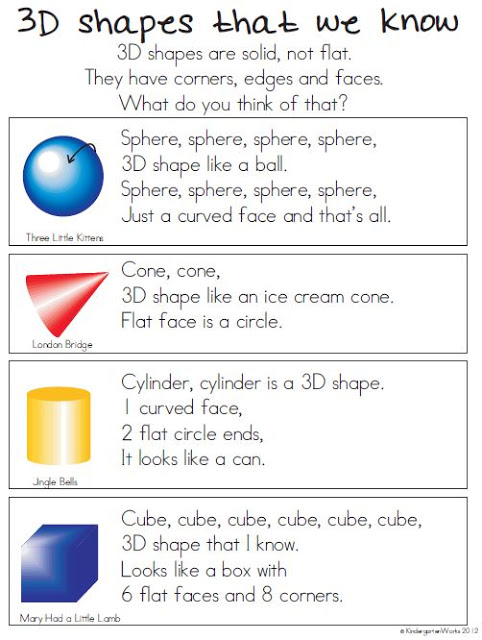
Figure 1: The K1 list of innate solids—sphere, cone, cylinder, and cube. These are the shapes that are most readily discernible at the earliest age. We can group them in different ways. Are some ways of grouping more illuminating than others?
In K2, two more are added: rectangular prism and (right) pyramid. This list really only contains five shape types, since a cube is just one case of “rectangular prism.” The only important addition is the pyramid —
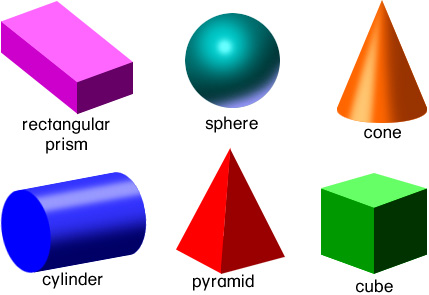
Figure 2: The K2 list of innately familiar solids plus something a bit more involved—the square pyramid.
Finally, in First Grade, this list is augmented to include the Platonic solids, ellipsoid, and various n-gonal “prisms” —

Figure 3: The G1 list of innately familiar solids, plus three new classes: pyramids, prisms, and Platonic solids.
Well, while zoning out and admiring the shapes in Figure 1, it occurred to me that “one of these things is not like the others, that one of these things just doesn’t belong.” It’s the cube. And this got me thinking about how we classify things …
Think of the process involved in schematizing an ideal solid. The a priori field of image making in general is 2D. The most elementary visible object is the line segment, though what is really presented in intuition is minimally a color boundary, more probably a (very thin) n-gon with two (very long) parallel sides. After that, the triangle and all the n-gons.
It is these objects—the two-dimensional ones—that are easiest to imagine. Now, how did we make them? In every case, we (1) minimize the area of our attention to the smallest size, which increases distinctness and exactness. Doing so increases the presence and reality of the object. Given the imagination’s default black background, It is easier to sustain the identity and presence of an imaginary tiny white dot than a large circle. This is because we can take-in the dot while staying at rest. The dot can be apprehended while the mind is fixe and unmoving. But to take-in a circle, we have to move around and talk to ourselves a little, and the parts that we are not “on top of” at the moment evaporate into the low-resolution “mist of the peripheral” familiar from human vision studies.
Making 0D (where knowing and being identify)
We make a dot just by focusing our awareness. The smaller the area, the more deeply (forcefully) does it merge with our intentionality, until the fiat of our attention and its target become one, and the locus realizes maximum presence. (Perhaps the “force of attention” is really the intensity of imaginary self-stimulation. Just as the amplitude of the external forces that perturb us correlate with the intensity of sensation (sensual presence), so there is also an intensity of imaginary positing.)
Making 1D
So the most elementary act of imaginary construction is the “point” (small, roughly circular area). To extend this “infinitesimal” area to encompass more space, we move it relative to “its” original position. And with this act, the “it”—now a substantial point—separates from the locus that previously “held” it. This is a radical break. Originally, these various elements were indistinguishable—subjective attention, intentionality, act of positing, locus of attention, locus of positing, and point-presentation. But when I detach the point as a substance by moving “it” away from the locus, all the elements just listed become distinct. With movement, the point becomes a thing separate from space. And by tracking its journey “from” its original location, a line is cognized/constructed.
Making 2D
The home objects of imagination are two-dimensional. These are built-up from their lower-dimensional components—segments. By moving a segment perpendicular to its length, a rectangle is made (and a plane is picked out). By rotating a segment on-end, a circle is made. These two moves—moving the segment sideways and rotating it on-end—are two basic motion algorithms for making 2D objects.
Making 3D
These same algorithms are used to make the ideal geometrical solids. The “most basic 3D shapes” from kindergarten, the ones that seem to accompany us from birth, are made by moving the “most basic 2D shapes” in similar ways—either (1) by rotating it around the vertical axis, or (2) by moving it perpendicular to the plan that contains it. We can call (1) axis-rotational construction and (2) perpendicular-lift construction. This difference in algorithm ought to be reflected in the constructed particulars by subsuming them as a class or type. We know that a red triangle and a red circle “belong” together “in” the same class, that of red things. Do we also recognize the commonality (essence) among rotation-made solids as being exemplified in some way? Do we spontaneously segregate solids according to their algorithms? Or is this something that is occluded in the moment of recognition?
The K1 list uses two rules
Having rotational and linear construction in mind, we can see that the objects from the K1 list (sphere, cone, cylinder, and cube) actually fall into two groups, according to how they are made. This becomes clear as soon as we realize that the four solids are generated from only three shapes—circle, triangle, and square (respectively). Note that I have arranged both lists by increasing number of (straight) sides—none, three, and four.
Now for our two algorithms—axis-rotation and perpendicular-lift. When I rotate these three shapes on their vertical axes, I produce a sphere, a cone, and a cylinder. What about the cube? Aha—now we have our answer. It is the cube that is the exception. The cube cannot be made (explained, or recognized) by the rule axis-rotation. It can only be made by means of perpendicular-lift.
The K2 list uses three rules
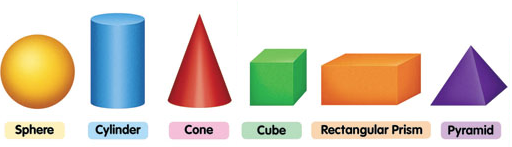
Figure 4: The K2 list again.
With this list, a third type of constructive algorithm is introduced. We can call this third procedure point-convergent construction. It is the method for making pyramids. Beginning with a regular n-gon, lines are draw from its vertices to a point above the centroid. In steps —
- Take a regular n-gon.
- Find its center, then lift it perpendicular to the n-gon’s plane of incidence.
- Draw lines from each vertex on the n-gon to the lifted point.
Thus the K2 list contains constructions from three rules (and objects that are members of three classes) —
- Axis-rotational construction: circle, triangle, square → sphere, cone, cylinder
- Perpendicular-lift construction: square (n-gon) → cube (n-gonal prism prism)
- Point-convergent construction: square (n-gon) → right pyramid
The G1 list uses four rules
Figure 3: The G1 list again.
This list clarifies two things and adds a third. First, adding the “prisms” lets us grasp the method (perpendicular-lift construction) we’ve been using all along to make the cube. Not only a square, but also a triangle, pentagon, and so on (recursively for every n-gon) can be lifted to make a simple 3D object. Second, adding other pyramids brings out their commonality (their rule of construction). But third and more importantly, a new rule is introduced:
- Platonic solid construction — Enclose a volume of space using congruent, regular polygonal faces with the same number of faces meeting at each vertex.
There are only five Platonic solids. In classical order, they are the octahedron, icosahedron, dodecahedron, tetrahedron, and cube.
| 2D seed | Rotate | Lift | Contract | Fit test |
|---|---|---|---|---|
| circle | sphere | cylinder | cone | N/A |
| triangle | cone | triangular prism | tetrahedron | tetra/octa/icosahedron |
| square | cylinder | cuboid | 4-sided pyramid | cube |
| pentagon | N/C | pentagonal prism | 5-sided pyramid | dodecahedron |
The Platonic solids they do not strike the infant as past-life familiars, but they are more exciting (and are the reason why AD&D makes such an exciting first impression).
Why aren’t they more basic?
Why aren’t the Platonic solids included in the the K1 list? It is because they do not strike the human infant as past-life familiars. The forms are a priori and synthetic, like the objects generated from the three simple motion rules, but their rule of construction is radically different. The innate solids are one and all made by moving a 2D object in one or more ultra-simple ways. But Platonic solids are made slowly, by trial and error, in an act of empirical discovery, where the thing must be constructed in space through testing. If you hand me a stack of hexagons, it will take me some time to construct the dodecahedron as a synthetic unity. Only afterwards can I count its faces, edges, and vertices; or visualize the cube that is incident with certain vertices; or see that the Golden Ratio [ϕ] holds between an edge of this cube and an edge of the dodecahedron; or discover that the dihedral angle of its vertices is 2 arctan(ϕ).
Bonus reading: