Phantasm
VIEW CONTEXT: Austin Retard Redux
VIEW DATE: 2017
People love it because (1) nostalgia, (2) wanting to have belonged to the now-nostalgic cohort, and (3) because of the male bonding.
When I lived in India, every day during lunch break the Indian taxi guys would be standing outside their cars and just hugging and rubbing and fondling and snuggling and leaning back into each other like a damn Rasa lila painting. Were they gay? Surely that would defy statistics for ALL taxi guys to be gay. Yet here they were, one leaning backwards into the embrace of another who would stroke his breasts and hair. Then it hits you—none of them are gay. They’re just normal primates being friendly with each other. We all want to have kindness and care of the brotherly kind with anybody and everybody. This immediate and concrete image—the social loving the social by default through concrete touch—is the beginning and end of utopia.
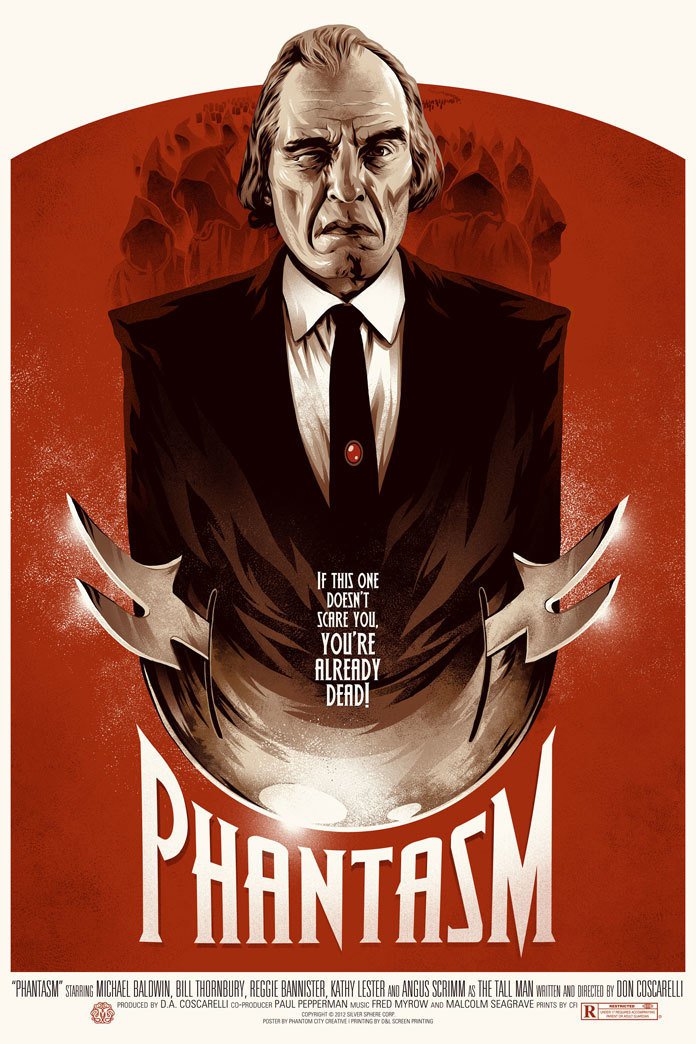
This is a really handsome poster, and a solid tribute to the very gracious and tender-hearted Angus Scrimm, who now has me under his spell.
This, I claim, from having spent the last four days reading hundreds of Phantasm reviews online, is why people love the film. It shows a caring white American culture that never was but could have been. What unites is always the adversary, and of course the film provides that element, too. And because the Tall Man is the glue between Jody and Reggie and Mike, he is also precious and beloved.
An evil sexy-skanky chick snarling at you flirtatiously while fondling a knife is absolutely sexy for young boys under all circumstances. A scary old guy—tall with an unnaturally blocky Germanic square jaw—is always good. He is the evil John Carradine-type, probably fully of nasty and sinister habits that he indulges in the dark. Probably likes corporeal punishment. The angry child-hating redneck would be American analog of the Child Hater archetype—the familiar “I’m gonna beat thuh shit outta you. Put a little fear of God in yuh, fer Jesus’ sake! Gonna stomp yer little motherfuckin’ ass!” guy. The redneck Trump supporter who has wet dreams about beating and terrorizing scared boys. A bully is what I mean, I suppose. This attitude is captured, or is meant to be captured, in his famous catchphrase,
Boy!
After 38 years of wondering, I finally watched it. I was shocked by how crappy it was. But then, by watching it again and again, and reading fan mail, and watching it again, I finally accessed the value. It was, first, nostalgia for the 70s, which seemed less police-saturated. And second, the (for us) borderline homo affection between (1) Mike and his older brother, and (2) Mike and Reggie. Never in any movie has male–male affection been displayed so baldly. The final attractant—I can try to imagine how I would have felt if I had seen it at age 10. Would I have been scared by any of it? I pretend that I would, and then my body feels enveloped in warmth.

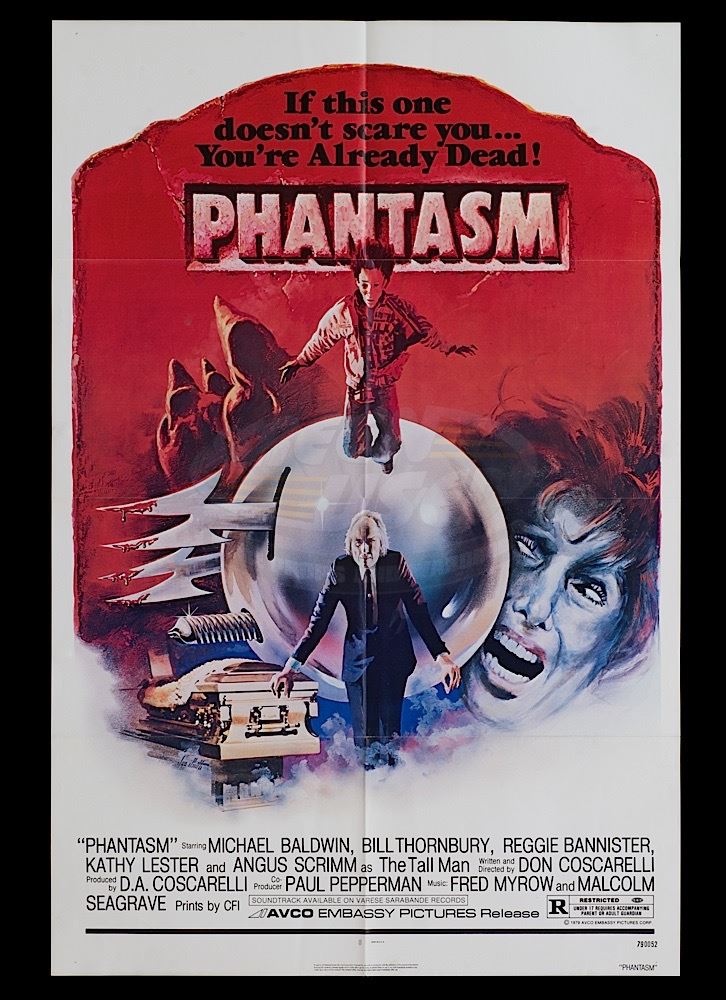
Another great poster, combining the Four Essentials (Mike, Tall Man, Ball, and Goddess)—plus the spiritual element of extra-dimensional falling—into one attractive watercolor.
Oh, I forgot to mention. The film does have one good redeeming horror aspect. The Tall Man is not just the totem of enraged and resentful adulthood in its war against young lust. He also carries within himself a vast, romantic, and very attractive hyper-dimensional space. His realm is not “another planet” but another plane. The plane itself is an endless Lovecraftian desert, utterly empty, making any visitor utterly alone.
Ode to the Inter-Dimensional Portal
There is a dream that occurs in all Americans at least once in a lifetime. It is a dream that occurs around the time of puberty—the dream of being utterly alone in all of infinite space. Mine occurred in an Arabian setting—a vast desert under clearest blue sky, cloudless, sun bright and everywhere, everything illumined on all sides with that uncanny all-pervasive brightness.
I knew that I was utterly alone, and that space was infinite. I intuited directly, despite Kant’s claims to the contrary, that space was bound-less, for I was flying above it and “knew” its infinity in that psychic way only available to dreamers, who enjoy the epistemic certainty of authors without identifying themselves with the role. And I knew that, if I died, the winter-bright and self-illumined space would continue to exist. (And isn’t that the essence of space? Space is that which we feel must continue to exist after our death?)
Something of this infinity and eternality was captured in the movie’s famous Dimensional Gateway scene. A procession of hooded dwarves (horribly compressed humans) snakes through an infinite plane of sand dunes under a throbbing Led Zeppelin sky, with that lovely background drone. The deep drone of the Dark Ungrund throbs the echoing halls. And he carries also the blinding light of the Dimensional Gateway room. The dark Lovecraftian Zeppelin desert sky and the bright horror of death by electroshock combine here—inside the exceptional atmosphere of the gorgeous, pristine, and glowing marble mausoleum.
And in that room the light is bright and blinding. It is a light that kills by overloading the body with energy, like fire. It is trauma-inducing—something LRH would include as one of his hilarious Primal Shared Implants constituting humanity’s collective Fall.