Seven Types of Consumer (Y&R)
Oh Psychology, you were supposed to become the Queen of the Liberal Arts, spirit’s science of itself, but you became an Inception weapon.
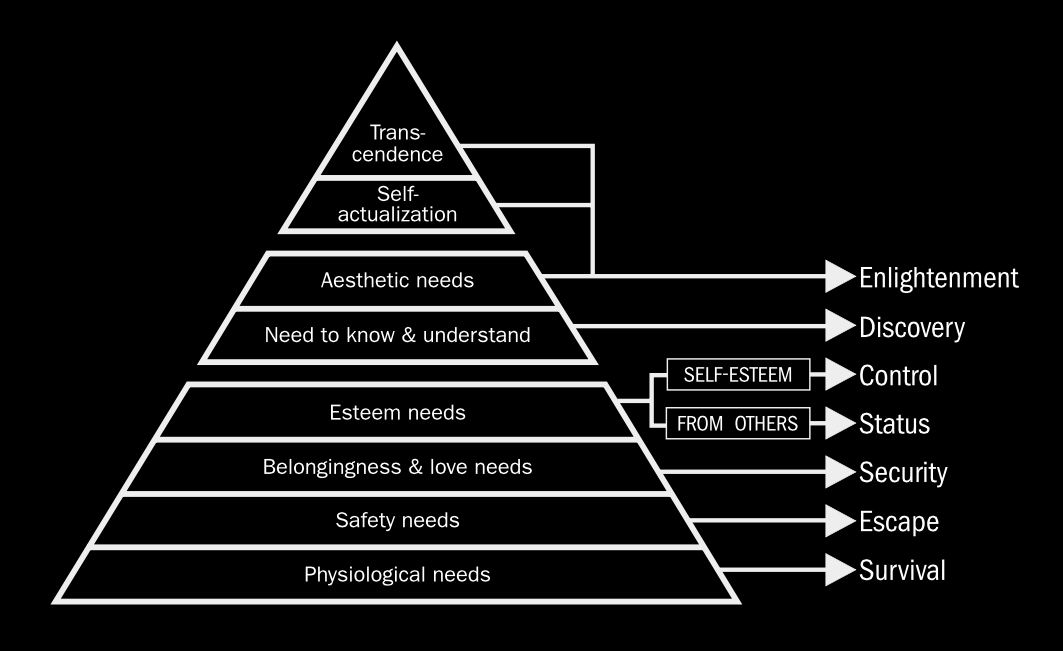
Since 1923, marketing has been psychology. The famous fruit of this marriage was the adaptation of Maslow’s “hierarchy of human needs” as a categorical typology of consumers’ self-concepts.
Y&R, the company that developed and promoted this typology, touts it today in a popular pamphlet that comes with the following opening:
Dr Maslow then went on to study the human beings around him.
Humans, he found, acted in much the same way. No human worried about love before they felt secure. No human sought control before they felt respected by their peers.
Thus was born Dr Maslow’s famous Hierarchy of Needs. Young and Rubicam took this hierarchy, and designed a probing research tool to find out where people stood within it.
The result was a segmentation system powerful enough to segment all mankind, and deep enough to understand all mankind’s basic motivations.
Because Young & Rubicam also asked what brands people bought and how they felt about them, the system also became a way of understanding the deeper appeals of those brands.
The system accepted that people from different countries were influenced by their differing cultural backgrounds, and removed the effect of those backgrounds.
And so it was named the Cross Cultural Consumer Characterization, or ‘4Cs’ for short.
4Cs divides people into seven types, depending on their core motivation. Shades of grey within the types come from the secondary motivations of their members.
This booklet describes the seven types.
You can find out what type you are by taking the short online test at http://www.4Cs.yr.com/diys
You can click here to see a devotee’s online flip-through version, here for a scary example of the system’s practical utility, or click the button below to download the handy PDF:
|
|
Y&R: The Seven Types of Consumer |
The Explorer
These people are driven by a need for discovery, challenge and new frontiers.
Young in nature, if not in reality, Explorers are often the first to try out new ideas and experiences.
They respond to brands that offer new sensations, indulgence and instant effects.
In short, difference is what they seek out. Their core need in life is for discovery.
The Aspirer
Materialistic, acquisitive people, who are driven by others’ perceptions of them rather than by their own values.
As a result, they respond to what others perceive as being superficial: image, appearance, persona, charisma and fashion. An attractive pack is as important to them as its contents.
Their core need in life is for status.
The Succeeder
Succeeders possess self-confidence, have a strong goal orientation and tend to be very organized.
As a result, they tend to occupy positions of respon- sibility in society. Their investment in the status quo means they tend to support it.
When it comes to brands, they seek reward and prestige, and will often seek out the best, because that is what they feel they deserve.
On the other hand, they also seek out caring and protective brands – their aggressive attitude to life means they need to relax occasionally.
Their core need in life is for control.
The Reformer
“Don’t tell me what to do or what to think” says the Reformer, valuing their own independent judgement.
Reformers are the most anti-materialistic of the seven groups, and are often perceived as intellectual.
They are socially aware, and pride themselves on tolerance.
Reformers seek out the authentic and the harmonious, and are often at the leading edge of society.
However, unlike Explorers, they will not buy things just because they are new.
Their core need in life is for enlightenment.
The Mainstream
These are people who live in the world of the domestic and the everyday.
A daily routine is fundamental to the way they live their lives. Their life choices are ‘we’ rather than ‘me’.
As their name implies, they are the mainstream of society. They are the largest group of people within 4Cs across the world.
They respond to big established brands, to ‘family’ brands and to offers of value for money.
Their core need in life is for security.
The Struggler
Strugglers live for today, and make few plans for tomorrow.
Others often see them as victims, losers and wasters - aimless, disorganised people with few resources apart from their own physical skills.
If they get on in life, it will depend more on a winning lottery ticket than anything they do themselves.
They are heavy consumers of alcohol and junk food.
Visual impact and physical sensation are an important element of their brand choices.
In essence, they seek escape.
The Resigned
These are predominantly older people with constant, unchanging values built up over time.
For them, the past is bathed in a warm nostalgic glow.
They respect institutions and enjoy acting in traditional roles.
Their brand choices are driven by a need for safety and for economy. They choose above all what is familiar to them.
In life, their aim is basic: it is to survive.