Why “CSH” Tech?

1971: sh
In the beginning, there was the Thompson shell, aka sh (1971). This was the first Unix shell, introduced with the original Unix written by Ken Thompson. A shell is a command-line interpreter, allowing interaction between agentive human and mechanical kernel. with high-level commands subsumptive of many kernel functions. With I/O direction (using < and > to redirect info into and from files) in a single command, and pipes (using |), a closer link was formed between desire and its fulfillment. It allowed for things like this to be effected through a single complex command:
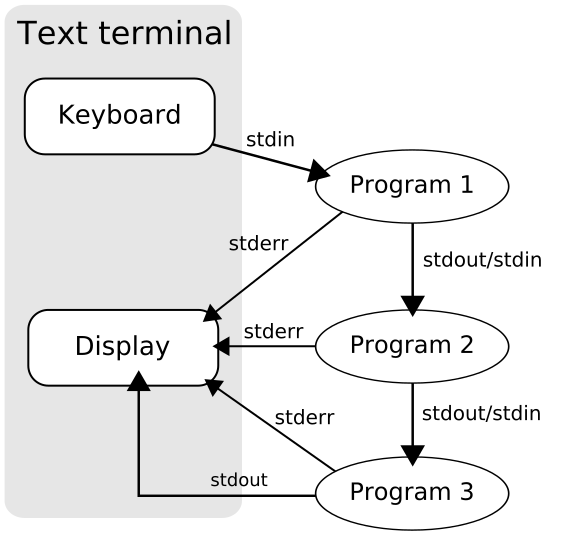
The ontology of piping stdout to another internal stdin automatically.
1978: csh
Seven years later, there was the C shell aka csh (1978)—The vastly improved Unix shell written by Bill Joy that made sh into an omnipotent and self-contained microverse: the history and editing mechanisms on the command line, aliases and tilde notation (macros), job-convenient directory stacks, time-saving path hashing and cdpath, and job control (single-window multitasking).
2008: CSH Tech
40 years later, there was CSH Tech. CSH Tech is the csh of tech. It is post-placebo, post-confirmation bias, and based (when possible) on actually valid intervention research—i.e., gold standard RDBPC studies.
Otherwise (and mostly) it is just for fun—experiments in self-modulation through placeboic use of metaphor and associated exercises.
Which is what we are all doing all the time anyway.
Does this make CSH Tech mere fiction? It would, except for the fact that metaphors that are workable or desirable (or marketable, sadly the ultimate empirical test for desirability) are just those that fit with the intersubjective metaphor vocabulary of the current Zeitgeist. The best window into an culture’s theory of mind is to discover its metaphors for self and consciousness and the strange little rituals it uses in the attempt to govern it. The language of placebo is the langue of self-mastery and, also, self-model.
The CSH Tech that is not based on actual research is illuminating because it puts our collective metaphors about selfhood, suffering, and power on display as (1) a model and (2) an intervention based on this model. One interesting discovery has been the persistence in my own thinking of the hydraulic model of selfhood. This was so interesting that I decided to write a history of it. It has since been “put on hold” (i.e., abandoned) like most of my most-interesting projects, so that I might do something actually useful for myself, like publish the journal article I need to write based on my dissertation. The project is (was?) called Metaphor and Psychotherapy, and you can check it out here.